 An Empirical Analysis of Secure Federated Learning for Autonomous Vehicle Applications
Abstract
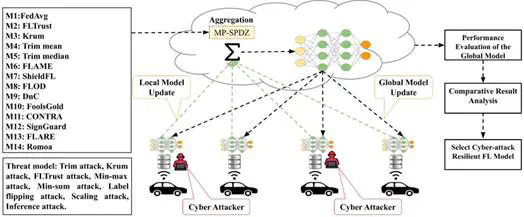
Federated Learning lends itself as a promising paradigm in enabling distributed learning for autonomous vehicle applications and ensuring data privacy while enhancing predictive model performance through collaborative training on edge client vehicles. However, it remains vulnerable to various categories of cyberattacks, necessitating more robust security measures to effectively mitigate potential threats. Poisoning attacks and inference attacks are commonly initiated within the federated learning environment to compromise secure system performance. Secure aggregation can limit the disclosure of sensitive information from outsider and insider attackers of the federated learning environment. This study conducts an empirical analysis on the transportation image dataset (e.g., LISA traffic light) using various secure aggregation techniques and multiparty computation in the presence of diverse categories of cyberattacks. Multiparty computation serves as a state-of-the-art security mechanism, offering privacy-preserving aggregation of autonomous vehicle local model updates through multiple security protocols. The presence of adversaries can mislead autonomous vehicle learning models, leading to traffic light misclassification and potentially hazardous outcomes. This empirical study explores the resilience of secure federated learning aggregation techniques and multiparty computation in safeguarding autonomous vehicle applications against cyber threats during both training and inference.

Md Jueal Mia
Graduate Research Assistant
My research interests include Trustworthy AI, AI Security, Foundation Models, Large Language Models, Vision-Language Models, Agentic AI, Federated Learning, Privacy-Preserving Machine Learning, and Adversarial Machine Learning.